“A motion detector from the DIY store costs a fraction of the price – and it switches the lights off too.” Planners and installers hear this on almost every project. And it isn't wrong: compared with lights left permanently on, a simple detector really does save energy. But it only answers one of the many questions building operators face today. How much has actually been saved? How do I prove it in an ESG report or energy audit? Who is going to change the hold time in 40 corridors? And why is the open-plan office lit at 100 % at midday in bright sunshine? This guide compares simple, standalone motion detectors with networked lighting control – honestly, in concrete terms and with a worked example of total cost of ownership.
What a simple motion detector does – and what it doesn't
A typical standalone detector consists of a PIR sensor, a twilight switch and a relay. It detects movement, closes a contact and opens it again once a fixed hold time has elapsed. Nothing more. That makes it robust and inexpensive – and it is precisely why it quickly reaches its limits in professionally operated buildings. The six most important limitations:
1. No metering, no proof
A relay detector has no idea how much energy it has saved. It measures no consumption and reports nothing. That leaves you without the basis for everything that is now standard in facility management: evidence of savings for ESG and sustainability reports, KPIs for an ISO 50001 energy management system, data for energy audits and for the implementation plans required under the Energy Efficiency Act (EnEfG). The Building Modernisation Act (GModG) also relies on monitoring technology whose data is accessible via a common interface (details in our guide to German energy efficiency laws). Without metering, every saving remains a claim.
2. Every sensor is an island
Standalone detectors do not communicate with one another. In a corridor, each detector switches only “its own” luminaires – as soon as you turn a corner, you walk into a dark section until the next detector responds. A group or corridor function, in which neighbouring luminaires go to an orientation level of, say, 20 % while the luminaire above you dims up to full output, is not possible this way. There is also no central overview: you only find out that a detector has failed or is stuck on when someone complains – or not at all.
3. Only on or off
Most simple detectors know just two states. That means missing out on the biggest levers for savings:
- Daylight harvesting: the luminaire dims down smoothly when enough daylight is available. In zones near windows this is often the single largest lever. Find out more in our guide to daylight harvesting.
- Constant light control and task tuning: new LED installations are frequently over-dimensioned. A deliberately reduced maximum level saves energy permanently without anyone noticing.
- Scenes and schedules: cleaning mode, meetings, night-time set-back – none of this can be implemented with simple relay switching.
Then there is comfort: lights switching off abruptly in occupied rooms leads to complaints, and in practice these are almost always “solved” with a longer hold time – which cancels out part of the savings.
4. Every change needs a ladder
Hold time too short? Sensitivity too high? With a standalone detector, that means calling out a technician, setting up a ladder and turning a potentiometer – one detector at a time. With 60 detectors in a building, every change of use becomes a service job. There are no updates for new features; you get the functionality that was built in on the day of installation.
5. No connection to the building management system
Simple detectors have neither BACnet nor any other data interface. This rules out occupancy data for space management, fault reports for predictive maintenance or links to heating and ventilation. Yet this data is often worth more than the lighting savings themselves, as our guide to energy monitoring and occupancy data shows.
6. The low price is only the beginning
The purchase price is the most visible cost item, but the smallest. Installation, site visits for adjustments, missed savings and replacing faulty devices add up over the service life. The worked example below shows how.
Head-to-head comparison
| Criterion | Simple motion detector | Networked lighting control |
|---|---|---|
| Energy consumption metering | no | yes, e.g. every 15 minutes per zone (CR01-ETC) |
| Evidence of savings for ESG, audits, ISO 50001 | not possible | consumption data and reports |
| Communication between sensors | none | group and corridor logic via Bluetooth Mesh |
| Dimming, daylight harvesting | usually not, on/off only | yes, integrated in luminaire-level sensors |
| Scenes and schedules | no | scene switches, synchronised schedules |
| Changing parameters | on site, detector by detector | via app or web interface |
| Central overview | none | EnergyCenter: real-time data, system events, floor plans |
| BMS integration | none | BACnet/IP via AU-Manager |
| Occupancy data for space management | none | yes |
| Best suited to | individual rooms with short-term use | offices, corridors, warehouses, schools, portfolios |
Worked example: total cost over ten years
Assumptions: office floor with 50 LED luminaires at 40 W each, 2,500 operating hours per year without controls, electricity price €0.25/kWh. Savings with a simple detector (presence only, on/off): 30 %. Savings with networked lighting control (presence, daylight harvesting, reduced lighting level, corridor logic): 50 %. Adjustments to standalone detectors: two site visits per year at €160 each (travel and labour); with the networked system, parameters are changed via app or remote access.
| Item (per year) | Simple motion detector | Networked lighting control |
|---|---|---|
| Consumption without controls | 5,000 kWh / €1,250 | 5,000 kWh / €1,250 |
| Energy savings | 1,500 kWh / €375 | 2,500 kWh / €625 |
| Site visits for adjustments | €320 | €0 |
| Metering and evidence | not available | included |
| Networked advantage per year | – | €250 energy + €320 service = €570 |
| Networked advantage over 10 years | – | €5,700 |
The calculation shows that even with cautious assumptions, the amount at stake over the service life often covers the additional investment in networked lighting control. This does not yet include the value of the data for reporting and space planning, lower effort when layouts change, or the comfort gain for occupants. Our guide to calculating lighting control savings explains how to set realistic savings rates.
How networked lighting control solves the six problems
The Keilton+autani system from Building Robotics is based on Bluetooth Mesh: sensors, luminaire nodes, switches and gateways form a wireless network without additional control cables (see our guide to Bluetooth Mesh lighting control for the fundamentals). In practice, this means:
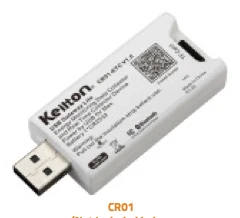
- Measure and prove: the CR01-ETC variant of the CR01 records the zone's energy consumption data every 15 minutes and generates usage reports from it. Its real-time clock also synchronises all devices in the zone for precise schedules.
- Central control and analysis: the AU-Manager with EnergyCenter software displays real-time and historical energy consumption graphically, stores system events for over a year and allows schedules and changes via the web interface – including secure remote access and on floor plans.
- BMS integration: the AU-Manager can provide data via BACnet/IP; the CR05 gateway connects a zone with up to 100 nodes to the platform. Find out more in our guide to BMS integration via BACnet and Modbus.
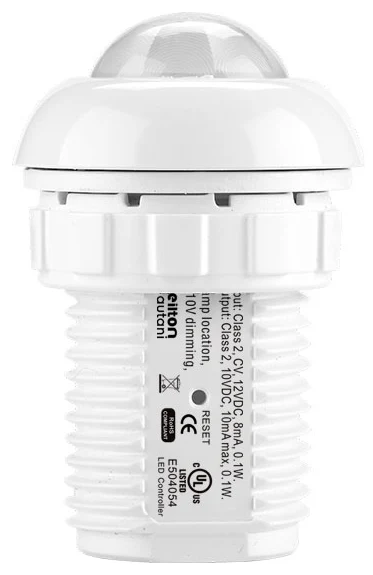
- Luminaire-level dimming and daylight harvesting: the IFS105SE combines PIR presence detection and daylight harvesting for mounting heights of 2 to 5 m, and the AlgoH2 algorithm minimises false triggers. For high-bay applications up to 22 m, the EFS106 offers the same combination.
- Scenes at the touch of a button: the battery-powered WP108E wall switch provides four configurable scene buttons plus separate DIM+/DIM- buttons and can be fitted at existing switch positions without new cabling.
- Cable-free retrofitting: where luminaires are not to be replaced, the battery-powered BCS107 ceiling sensor adds presence detection and daylight harvesting – with a battery life of up to 10 years.
Making the right decision
Ask yourself three questions for each area:
- Do I need to prove consumption or savings? Then you need metering – a relay detector is ruled out.
- Is there daylight, long periods of use or contiguous spaces? Then dimming, daylight harvesting and group logic account for the bulk of the savings.
- Will the use of the space change over the years? Then every adjustment made via app rather than by ladder pays for itself several times over.
If every answer is “no”, a simple detector is a sensible choice. In offices, corridors, schools, warehouses and building portfolios, at least one answer is almost always “yes”.
Conclusion
A cheap motion detector saves energy – but it does so blindly, in isolation and only in part. It measures nothing, reports nothing, cannot dim and requires a technician's visit for every change. That is fine for individual ancillary rooms. Wherever you want to prove savings, meet reporting obligations, deliver comfort and use the big levers such as daylight harvesting and group logic, networked lighting control is usually the more economical solution over the service life. The purchase price is the smallest item – what matters is what the installation has delivered and proven after ten years. For an assessment of your building, feel free to contact us.
Try it interactively
Savings calculator
Frequently asked questions
Isn't a simple motion detector enough to save energy?
Compared with lights left permanently on, it certainly saves energy, but it only taps part of the potential. Dimming, daylight harvesting, reduced lighting levels and group logic are usually missing. It also cannot measure or prove the savings.
When is a simple motion detector the right choice?
In individual rooms with short-term use and no daylight, such as storerooms, cellars, garages or stairwells in small buildings. If no data needs to be analysed and no reporting obligations apply there, networking adds little value.
Why is metering energy consumption so important?
Without metering, no saving can be proven – whether in an ESG report, an energy audit or an ISO 50001 energy management system. The German Energy Efficiency Act (EnEfG) and Building Modernisation Act (GModG) also rely on traceable consumption data. In the Keilton+autani system, the CR01-ETC records a zone's consumption data every 15 minutes.
Can networked sensors be connected to the building management system?
Yes. In the Keilton+autani system, the CR05 gateway connects a zone with up to 100 nodes to the Autani platform, and the AU-Manager with EnergyCenter software provides data via BACnet/IP.
Do I need to install new cabling for networked lighting control?
No. Bluetooth Mesh communicates wirelessly; sensors and luminaire nodes only need their power supply. Battery-powered devices such as the BCS107 ceiling sensor, with a battery life of up to 10 years, or the WP108E wall switch need no cabling at all.
How do I work out whether networked lighting control pays off for my building?
Use your consumption, operating hours, electricity price and realistic savings rates, and factor in service costs for adjustments. The Building Robotics savings calculator helps with the estimate, and the room simulator shows the effect of individual functions.