High bay sensors are occupancy and daylight sensors designed specifically for the large mounting heights found in warehouses, distribution centres, production halls and logistics facilities. Reliable detection at heights of up to 22 m comes down to three things: the right lens for the height and geometry, a well-planned sensor grid with no gaps in coverage, and dealing with sources of interference such as forklifts, warm-air heaters and direct sunlight. Planned properly, high bay sensors switch and dim warehouse lighting according to actual demand – making large halls one of the most rewarding applications for lighting control there is. This guide explains what matters when it comes to planning, lens selection and commissioning.
Why warehouses need special sensors
A standard office occupancy sensor is designed for mounting heights of just a few metres. As the height increases, conditions change fundamentally:
- The heat signature gets weaker. A PIR sensor can only detect a person 15 m away with optics that concentrate its field of view.
- Geometry becomes more important. Aisles, high-bay racking and machinery restrict the line of sight. The sensor has to "look into" the aisle, not at the tops of the racks.
- Sources of interference multiply. Heater fans, warm machinery, doors and rooflights cause changes in temperature and light that can trigger false activations.
- The environment is harsher. Dust, moisture, cold or outdoor areas call for more robust housings.
High bay sensors address this with interchangeable lenses, adapted evaluation algorithms and suitable IP ratings.
High bay sensors at a glance
| Sensor | Power supply | Mounting height | IP rating | Key features |
|---|---|---|---|---|
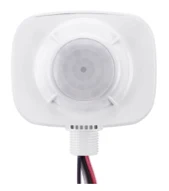
| EFS104 | 120–277 V AC, integrated power supply | > 6 m, up to 22 m with HBL3-2 lens | IP40 | mains-powered, daylight harvesting |
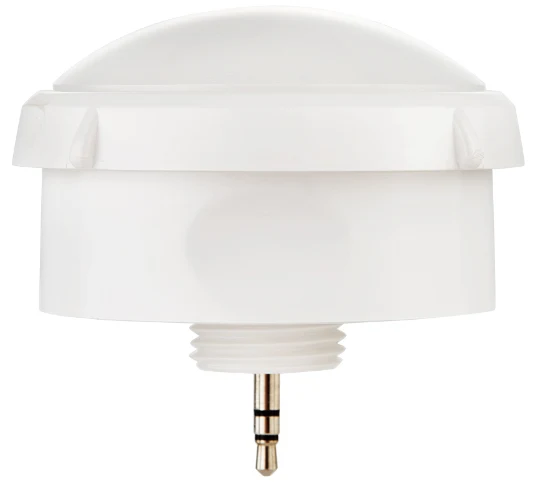
| EFS106 | 12 V DC via AUX interface | 5–22 m | IP40 | for LLLC/NLC5, plug-and-play, HBL3-2 lens |
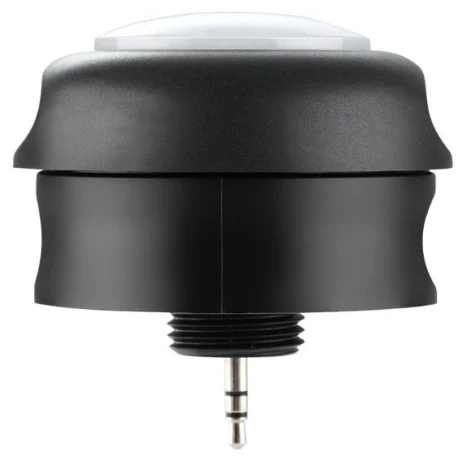
| EFS106W | 12 V DC via AUX interface | up to 22 m | IP66 | black UV-resistant nylon housing, photocell for Hold ON/OFF, WHBL3-2 lens |
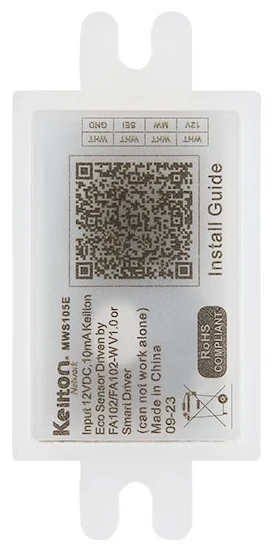
| MWS105E | 12 V DC via FA102 | up to 6.5 m | IP20 | microwave, detection up to 15 m, sensitivity 0–100 % |
All three EFS variants use PIR detection with the AlgoH2 algorithm, which is designed to improve detection at great heights and prevent false triggers, and they communicate via Bluetooth Mesh with a range of up to 100 m according to the datasheet. The datasheet specifies an operating temperature range of −33 °C to 65 °C – relevant for unheated warehouses or cold storage areas, for example.
EFS104 or EFS106?
The choice depends mainly on the luminaire:
- The EFS104 has an integrated power supply and connects directly to mains voltage. It is the right choice when the sensor is to be mounted externally on existing luminaires or close to a group of luminaires.
- The EFS106 is powered via a 12 V AUX interface and plugs directly into the luminaire. This is the route for luminaire manufacturers and for projects in which every high bay luminaire gets its own sensor – in other words, luminaire-level lighting control (LLLC).
- The EFS106W is the rugged variant for outdoor areas, canopies, loading bays, wash bays or damp production environments.
Choosing the right lens
The lens determines the size and shape of the detection area on the floor. For the EFS104 and EFS106, the HBL3-2 lens is available for heights of up to 22 m; for the EFS106W, the equivalent is the WHBL3-2. As a general rule:
- Greater height → more focused lens. The detection area becomes smaller relative to the height, but sensitivity at floor level is maintained.
- Aisles → directional detection. In high-bay warehouses, the sensor should cover its own aisle, not the neighbouring one. Position the sensor centrally above the aisle.
- Open areas → as circular a detection area as possible and an even grid.
Planning the sensor grid
Basic rules
- Allow for overlap: Adjacent detection areas should overlap. An overlap of around 10 to 20 % has proven a good guideline, so that people at the edges of the detection areas are also reliably detected.
- Consider the direction of movement: PIR sensors detect movement across the sensor more reliably than movement directly towards it. In aisles, people usually move lengthways – one sensor per aisle section with overlapping detection areas is more robust than a few widely spaced sensors.
- Create sensible zones: When several sensors are grouped into a zone, the light stays on as long as any sensor in the zone reports occupancy. Aisles, main traffic routes and picking areas should each have their own zones.
- Take doors and transitions into account: At doors and passageways, the light should already be on before a forklift reaches the zone. A sensor in front of the door or linking neighbouring zones solves this.
Background lighting instead of darkness
Switching off completely does not always make sense in warehouses. Often, dimming to a background level is the better strategy: the hall remains easy to navigate, cameras and people in the neighbouring area can see enough, and full light is available immediately when someone enters. Background levels of 10 to 30 % are commonly cited as a guideline; the right setting depends on how the space is used and on the risk assessment. Observe the requirements for workplaces and traffic routes set out in the German workplace lighting rule ASR A3.4 and EN 12464-1, as well as the requirements for emergency lighting, which must work independently of the lighting control system.
Avoiding false triggers
False activations cost energy and undermine confidence in the system. The most common causes in warehouses and how to fix them:
| Source of interference | Effect | Remedy |
|---|---|---|
| Warm-air heaters, radiant ceiling heaters | changing heat patterns trigger PIR | do not mount the sensor in the airflow, keep your distance |
| Direct sunlight through rooflights | changes in heat and light | do not point the sensor towards the rooflight strip |
| Doors, outdoor traffic | detection outside the hall | keep the detection area away from door openings |
| Neighbouring aisles | light comes on in the wrong aisle | sensor centred above the aisle, suitable lens |
| Warm machinery or motors | detected as movement | take the machine's location into account when positioning |
| Microwave in lightweight buildings | detection through walls | reduce sensitivity (MWS105E: 0–100 %) |
The AlgoH2 algorithm in the EFS sensors is designed to distinguish genuine occupancy from interference of this kind. Careful positioning nevertheless remains the most effective measure.
Using daylight in warehouses
Many warehouses have continuous rooflights, skylights or large doors. The EFS high bay sensors feature daylight harvesting and can dim or switch off the lighting when there is enough daylight. The EFS106W also offers a photocell for Hold ON/OFF operation, for example for canopies and outdoor areas. You will find background information on the control principles in our guide to daylight harvesting.
Commissioning and optimisation
- Walk-through with a forklift: Test detection with the actual vehicles and speeds, not just on foot.
- Time delays to match usage: Picking zones with constant traffic can take longer time delays; rarely used aisles, shorter ones.
- Reflect shift patterns: Time schedules for shift changes or weekends complement occupancy control. The CR01 real-time clock is available for synchronising a zone's timing.
- Analyse the data: Occupancy data shows which areas are hardly used and makes the case for further optimisation (see energy monitoring and occupancy data).
Cost-effectiveness
Warehouses have high connected loads, long operating hours and often large areas that are only used intermittently. That is why high bay sensors frequently pay for themselves particularly quickly. Combined with LED technology and networked control, lighting energy savings of up to 90 % are possible compared with uncontrolled legacy installations. Because the Keilton+autani sensors communicate via Bluetooth Mesh, there is no need for additional control cabling – a significant cost factor at mounting heights above 10 m, where any work at ceiling level requires mobile elevating work platforms. For a project-specific estimate, use the savings calculator; for specific warehouse projects, please get in touch via our contact page.
Conclusion
High bay sensors make warehouse and logistics lighting demand-driven – provided the lens, grid and mounting position suit the height, geometry and sources of interference. With the HBL3-2 lens, the EFS104 and EFS106 cover heights of up to 22 m, while the EFS106W brings IP66 protection for outdoor and damp areas. If you plan with background lighting instead of switching off, make use of daylight and commission the system with real traffic, you get reliable control with high savings potential.
Try it interactively
Grid planner
Frequently asked questions
Which occupancy sensor is suitable for high-ceilinged warehouses?
Warehouses need dedicated high bay sensors with focusing, interchangeable lenses. With the HBL3-2 lens, the Keilton+autani EFS104 and EFS106 sensors are designed for mounting heights of up to 22 m. For outdoor and damp areas, there is the IP66-rated EFS106W.
How many sensors does a warehouse need?
That depends on the mounting height, lens, hall geometry and aisle widths. Detection areas should overlap, and each aisle should be covered separately. The grid planner gives you an initial estimate; the manufacturers' detection patterns are what count.
Why does the warehouse lighting switch on for no reason?
Common causes include warm-air heaters, direct sunlight through rooflights, traffic in front of open doors or movement in the neighbouring aisle. The fix is a different sensor position, a suitable lens and, with microwave sensors, reduced sensitivity.
Should warehouse lighting be switched off completely when nobody is there?
Not always. Dimming to a background level – as a guideline 10 to 30 per cent – keeps the hall easy to navigate and ensures full light as soon as someone enters. The right strategy depends on usage, the risk assessment and the requirements for traffic routes.
Do high bay sensors also work in cold stores?
According to the datasheet, the EFS high bay sensors are specified for operating temperatures from minus 33 to plus 65 degrees Celsius. For the specific application, also check the IP rating, condensation and the luminaire's requirements.